
Paver Base Calculator
A paver project lasts only as long as its base. Enter your area and the type of project, and this calculator works out how much compacted gravel base and bedding sand to order, how deep to dig, how many pavers to buy and how much edging you need.
- Free to use
- No sign-up
- Runs in your browser
Paver base calculator
Paver Project Planner
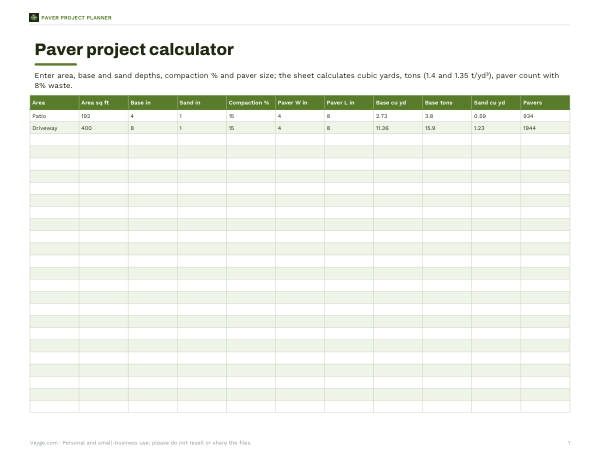
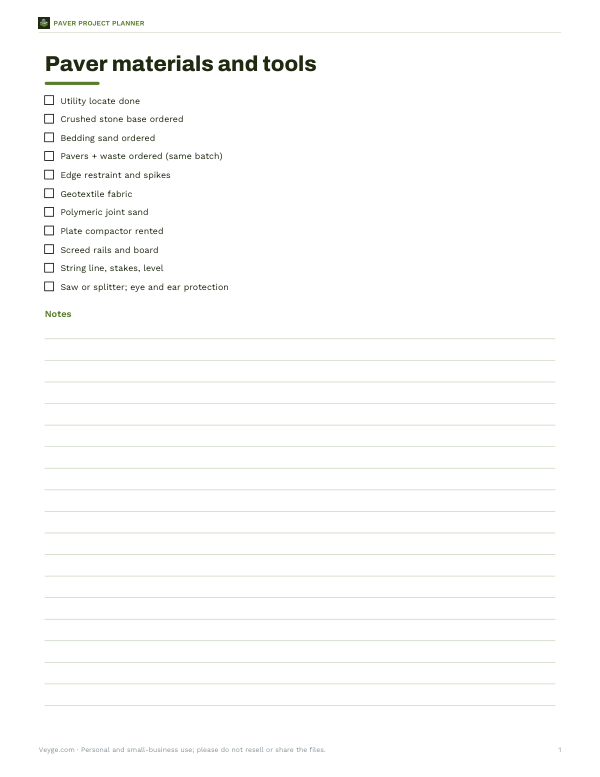
Excel paver project calculator (base, sand, pavers, edging and cost), a materials and tools checklist, a site layout grid and a project schedule.
- Project calculator (XLSX)
- Materials checklist (PDF/DOCX)
- Layout grid (PDF)
- Schedule (PDF/DOCX/XLSX)
Formats: XLSX, PDF, DOCX. Instant download after payment (link valid 72 hours, up to 5 downloads). AI-assisted: the templates were drafted with AI help and reviewed and laid out before publishing.
$5.00 USD, one-time 4 files · about $1.25 each
- Instant download
- 7-day refund
- Secure checkout by Stripe
7-day money-back guarantee. Full refund within 7 days of purchase, even after you download.
Free sample: Paver Materials Tools (PDF, 57 KB)
Full refund within 7 days — see the refund policy and license.
Free printables
Single sheets you can print right now, no sign-up. The full pack adds every sheet in one download plus the editable files.
 Printable Paver Project Schedule
The layers of a paver installation
| Layer | Typical thickness | Purpose |
|---|---|---|
| Subgrade (native soil) | Compacted | Firm, well-drained foundation |
| Geotextile (optional) | — | Separates base from soft or clay soil |
| Crushed stone base | 4–6 in for walkways and patios; 8–12 in for driveways | Load-bearing, drainage |
| Bedding sand | About 1 in | Level bed the pavers settle into |
| Pavers | About 2⅜ in (60 mm) for patios; 3⅛ in (80 mm) often for driveways | Wearing surface |
| Joint sand | Fills the joints | Locks pavers together |
These are common ranges from installation guides; follow the paver manufacturer’s instructions and local conditions — poorly draining or frost-prone soils need more base.
The formulas
| Quantity | Formula |
|---|---|
| Base volume (cu yd) | area (sq ft) × depth (in) ÷ 12 ÷ 27 × (1 + compaction allowance) |
| Sand volume (cu yd) | area × depth (in) ÷ 12 ÷ 27 |
| Tons | cubic yards × material density (tons per cu yd) |
| Pavers | area × 144 ÷ (paver length × width in inches) × (1 + waste) |
| Excavation | base + sand + paver thickness |
Loose gravel compacts, so order extra — allowances of 10–20% are common. A cubic yard is 27 cubic feet.
Worked example
A 12 × 16 ft patio (192 sq ft) on firm soil with a 4-inch base: 192 × 4 ÷ 12 ÷ 27 = 2.37 cu yd, plus 15% for compaction = 2.73 cu yd, about 3.8 tons of crushed stone. One inch of bedding sand is 0.59 cu yd (about 0.80 tons). With 4 × 8 in pavers and 8% waste, that’s 934 pavers, and about 56 ft of edge restraint. Digging depth is 4 + 1 + 2⅜ ≈ 7.4 inches below the finished surface.
Installation steps
- Mark the area and call before you dig to locate utilities.
- Excavate to depth, sloping about 1/8–1/4 inch per foot away from buildings for drainage.
- Compact the subgrade; lay geotextile if the soil is soft.
- Add base in 2–3 inch lifts, compacting each with a plate compactor.
- Screed the bedding sand level over rails — don’t compact it yet.
- Lay pavers in your pattern, cutting edges with a saw or splitter.
- Install edge restraints.
- Compact the pavers, sweep in joint sand and compact again.
Common paver patterns and waste
| Pattern | Look | Typical waste allowance |
|---|---|---|
| Running bond | Rows offset by half a paver — simple and classic | about 5% |
| Basket weave | Pairs alternating direction | about 5–8% |
| Herringbone (45° or 90°) | Zig-zag interlock — strongest for driveways | about 10–15% (more cuts) |
| Circles and fans | Decorative focal points | 15% or more |
Diagonal and herringbone layouts need more cuts at the edges, so order more pavers. Buy all your pavers from one production batch where possible, as colours vary between batches, and keep a few spares for future repairs.
Drainage and slope
Water is the main enemy of a paver installation. Build the base with a slope of about 1/8 to 1/4 inch per foot away from the house — roughly 1.5–3 inches over 12 feet — and make sure the surrounding ground can take the runoff. On clay soils that drain poorly, a thicker base, geotextile and in some cases a drainage pipe along the low edge are common solutions. Permeable paver systems use open-graded stone instead of dense base and are designed to let water soak through; they follow different base specifications.
Driveways vs patios
Driveways carry concentrated wheel loads, so they need a deeper base, thicker pavers (often 80 mm / 3⅛ inch) and a pattern that interlocks well, such as 45° or 90° herringbone. Patios and walkways carry foot traffic and furniture and can use a thinner base and standard 60 mm pavers on well-drained soil. If a patio might ever carry a vehicle — a garden tractor, a hot-tub delivery — build it to the driveway specification.
Renting a plate compactor
- Most tool-rental shops rent plate compactors by the half day or day.
- Compact the base in lifts of about 2–3 inches for the best density.
- Slightly damp base material compacts better than bone-dry or soaking wet.
- Use a pad on the compactor when compacting pavers to avoid chipping.
- Wear hearing and eye protection and steel-toe boots.
Choosing base material
- Use angular crushed stone with fines (often sold as road base, crusher run or “paver base”) — it locks together when compacted.
- Avoid rounded pea gravel for the base; it doesn’t compact.
- Use coarse, washed concrete sand for bedding — not play sand or stone dust in many manufacturer guides.
- Polymeric joint sand reduces weeds and washout; follow its curing instructions.
Privacy
All calculations run in your browser.
Frequently asked questions
How much paver base do I need?
Area × base depth ÷ 324 gives cubic yards; add 10–20% for compaction.
How deep should paver base be?
Commonly 4–6 in for patios and walkways and 8–12 in for driveways.
How many tons is a cubic yard of gravel?
Often about 1.3–1.5 tons, depending on the material — ask your supplier.
How much sand goes under pavers?
About 1 inch of bedding sand.
How many pavers per square foot?
144 ÷ paver area in square inches: 4.5 for 4 × 8 in pavers.
Do I need geotextile fabric?
It’s recommended over soft or clay soils to keep the base from mixing with the soil.
Can I lay pavers directly on soil?
Not for a durable result — pavers need a compacted base and bedding layer.
How much slope should a patio have?
About 1/8–1/4 inch per foot away from buildings.
How many bags of paver sand do I need?
Divide the sand volume in cubic feet by the bag size; 0.5 cu ft bags are common.